
How to Find the Memory Address of a Symbol in an ELF File
A quick and useful tip for locating symbol memory addresses in ELF files using arm-none-eabi-nm combined with grep—perfect for embedded debugging scenarios like setting up SEGGER RTT or inspecting linker placements and runtime symbols.

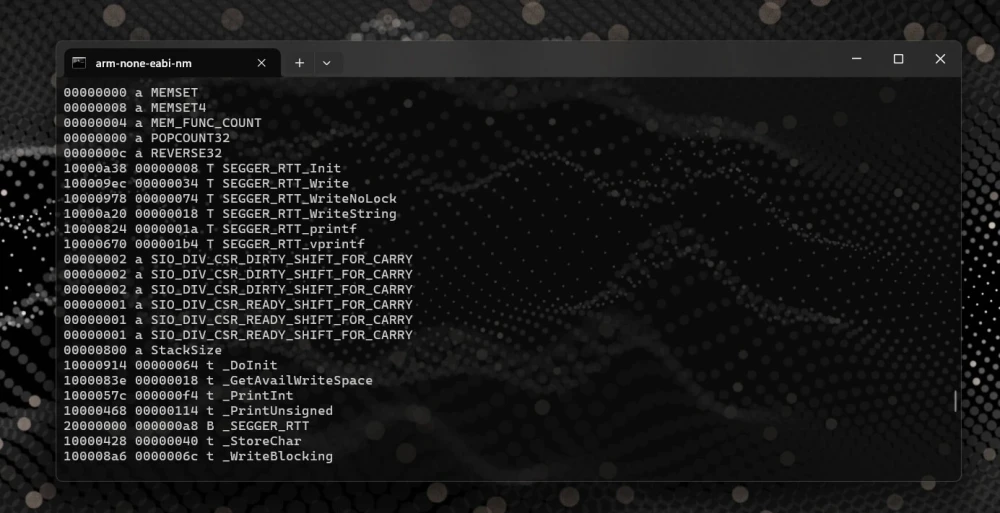
Here’s a handy tip that came up during some work with SEGGER RTT (Real Time Transfer).
When initializing an RTT session, you need to provide the memory address of the RTT static control block variable. While it’s possible to dig through your generated .map file, there's a faster way:
arm-none-eabi-nm blink.elf | grep _SEGGER_RTT
20000000 B _SEGGER_RTT
By piping the output of arm-none-eabi-nm (which lists all symbols in your .elf file) to grep, you can quickly isolate and retrieve the memory address of your desired symbol.
Note: For Windows users, grep is typically a Linux command. However, you can easily use this trick with tools like WSL (Windows Subsystem for Linux), Cmder, or Git Bash.
arm-none-eabi-nm firmware.elf | grep foo
1000033c T foo
This technique isn't limited to variable addresses, it's equally useful for finding function or constant data addresses. Variable symbols are typically stored in volatile RAM, while function code and constant data usually reside in non-volatile ROM or Flash memory, reflecting their runtime mutability or immutability.

How to Strip Debug Symbols from Software (and Still Keep GDB Context)
Learn how to use objcopy to strip debug symbols from an ELF executable, protecting sensitive data without losing the ability to debug your code using an external .dbg file and GDB.

Cortex-M0 Profiling: How to Trace Without Hardware Support
The ARM Cortex-M0 and M0+ lack hardware tracing features like SWO, ETM, and ITM, so how do you profile code on them? In this post, I explore software-based techniques to get deeper insight into performance and debugging on these resource-constrained MCUs.

Managing Multi-Compiler CMake Projects in VS Code
Learn how to build host utilities alongside embedded firmware in CMake by using ExternalProject. This guide covers setting up multiple compilers, integrating utility projects, and configuring VS Code workspaces for smooth IntelliSense.
Whether you're building something new, fixing stability issues, or automating what slows your team down — we can help.